What Is OSHC in Australia? Coverage, Costs and Requirements for Indian Students
27 Nov, 2026
Moving to Australia for higher education involves more than choosing a university, paying tuition fees and arranging accommodation. Indian students must also understand how healthcare works in Australia and how to manage medical expenses while studying abroad. One important requirement is Overseas Student Health Cover (OSHC), a type of health insurance designed for international students.
If you are planning to study in Australia, you may have questions such as: Is OSHC compulsory for Indian students? What medical treatments does it cover? How much does it cost? Can you choose your own insurance provider? Does it cover your spouse or children?
OSHC is generally a mandatory requirement for international students holding an Australian Student visa (subclass 500). However, having insurance does not mean every medical expense will be paid in full. Some treatments have benefit limits, exclusions and additional charges that students should understand before purchasing a policy.
This guide explains OSHC for Indian students, including Australian student visa health insurance requirements, medical coverage, costs, approved providers, policy duration and common mistakes to avoid. It also explains how to compare insurance options and use your policy after arriving in Australia.
What Is OSHC in Australia?
Overseas Student Health Cover (OSHC) is a type of private health insurance that helps international students pay for eligible medical and hospital treatment while living and studying in Australia.
The Australian Government requires most international students holding a Student visa (subclass 500) to maintain adequate OSHC throughout their stay. It helps students manage healthcare expenses, including doctor consultations, eligible hospital treatment, emergency ambulance services and certain prescription medicines.
Unlike Australia's public healthcare system, OSHC is specifically designed to meet the health insurance requirements of international students.
For Indian students, OSHC is particularly important because most are not eligible for Medicare, Australia's public health insurance scheme. Without suitable health insurance, medical treatment in Australia can become expensive.
OSHC vs Medicare: What Is the Difference?
Medicare is Australia's public healthcare system, primarily available to Australian citizens, permanent residents and certain eligible visitors under reciprocal healthcare arrangements.
OSHC, on the other hand, is designed for eligible international students who need health insurance to meet their Student visa requirements.
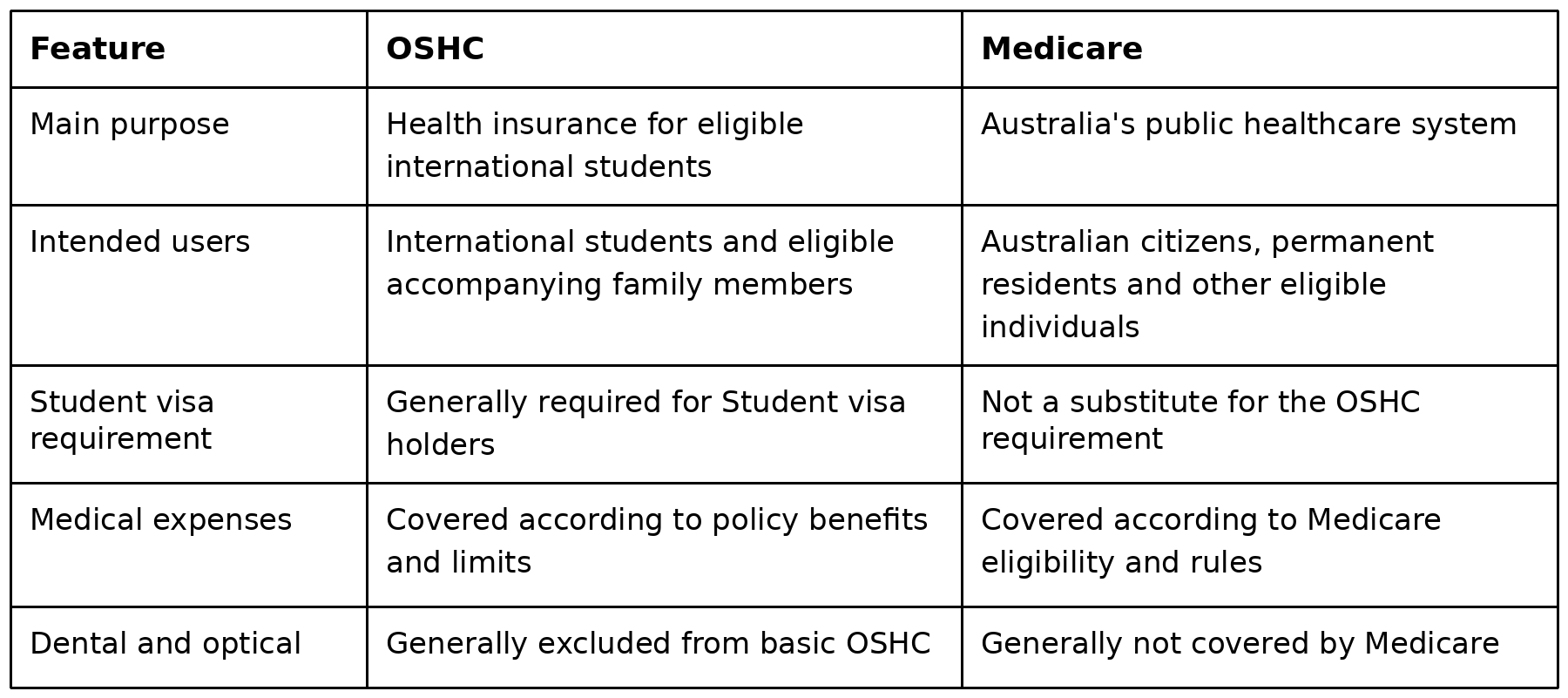
Indian students should not assume that they can use Medicare instead of OSHC. They should arrange an approved OSHC policy unless a specific exemption applies.
Is OSHC Mandatory for Indian Students?
Yes. OSHC is generally mandatory for Indian students applying for an Australian Student visa (subclass 500).
Under the health insurance requirements associated with the Student visa, applicants must provide evidence of adequate OSHC covering themselves and everyone included in their visa application.
Students must:
- Purchase OSHC from an approved Australian health insurer.
- Arrange insurance before travelling to Australia.
- Ensure the policy covers the required period of their stay.
- Maintain continuous insurance coverage while holding a Student visa in Australia.
- Include the relevant insurance details in their visa application.
If students arrange their own insurance, they generally need to provide the insurer's name, policy number and coverage dates in their visa application. If their education provider arranges the policy, they must provide the relevant provider and coverage details.
Failure to provide evidence of adequate insurance can result in a Student visa refusal.
Are There Any Exemptions?
Certain international students may be exempt from purchasing OSHC because of specific reciprocal healthcare arrangements.
The recognised exemptions include:
- Norwegian students covered by the Norwegian National Insurance Scheme.
- Swedish students covered by Kammarkollegiet.
- Belgian students covered under Australia's Reciprocal Health Care Agreement.
These exemptions are country-specific. Indian students generally do not qualify for them and should arrange OSHC before travelling to Australia.
What Does OSHC Cover in Australia?
OSHC helps international students pay for eligible medical services and hospital treatment. However, the exact benefits depend on the minimum requirements and the policy offered by the selected insurer.
Basic OSHC policies generally include the following services:
1. General Practitioner (GP) Consultations
A General Practitioner is usually the first healthcare professional students visit when they have an illness, minor injury or general health concern.
OSHC provides benefits towards eligible GP consultations. Some insurers also have direct-billing arrangements with selected clinics, allowing students to pay only the applicable gap fee, if any.
2. Specialist Medical Services
Students may need to consult specialists for specific health conditions.
Eligible specialist medical services receive benefits under OSHC, subject to applicable Medicare Benefits Schedule (MBS) rates, policy conditions and referral requirements.
Students should check whether a GP referral is necessary before booking a specialist appointment.
3. Hospital Treatment and Surgery
Basic OSHC includes eligible hospital treatment in public and private hospitals.
Depending on the treatment and policy conditions, this can include:
- Hospital accommodation.
- Medical treatment during hospital admission.
- Eligible surgical procedures.
- Related medical services.
Coverage at private hospitals can depend on whether the hospital has an agreement with the insurer. Students should confirm their benefits before arranging planned treatment.
4. Blood Tests, X-rays and Diagnostic Services
OSHC provides benefits for eligible diagnostic services, including blood tests and X-rays.
These services may be recommended by a doctor to investigate an illness, injury or medical condition. The amount paid by the insurer depends on the applicable benefit limits.
5. Emergency Ambulance Services
Emergency ambulance transport for eligible medical treatment is included in basic OSHC.
This is important because ambulance transport can be expensive in Australia. Students should understand the difference between emergency ambulance services and other transport arrangements, which may not receive the same benefits.
6. Prescription Medicines
OSHC includes limited benefits for certain prescription medicines.
Under the Australian Government's OSHC fact sheet, the basic pharmaceutical benefit is generally capped at:
- Up to AUD 50 per pharmaceutical item.
- Up to AUD 500 per year for single membership.
- Up to AUD 1,000 per year for couple or family membership.
These are benefit limits, not a promise that every medicine will be reimbursed. The medicine must meet the applicable policy requirements.
Students should check the insurer's pharmaceutical benefits before purchasing expensive prescription medicines.
What Is Not Covered by Basic OSHC?
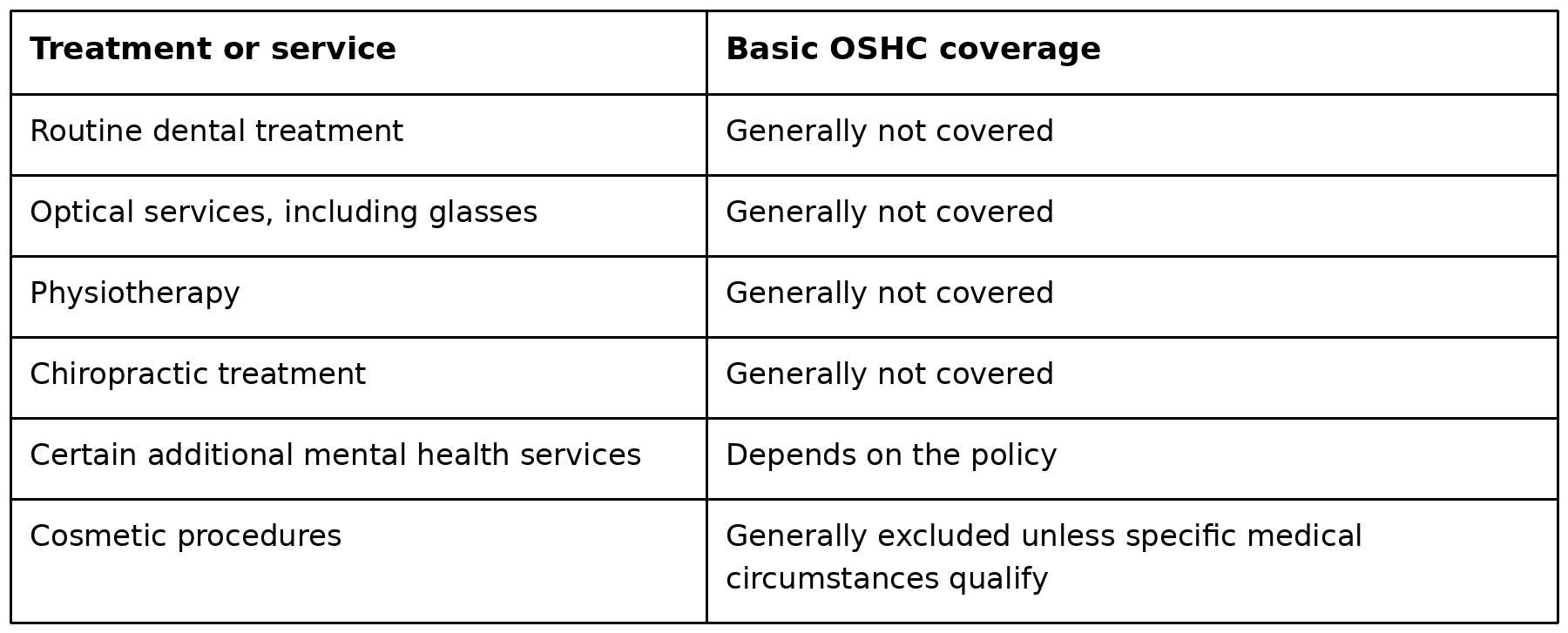
One common misunderstanding among international students is that OSHC pays for every type of medical treatment.
Basic OSHC has limitations. Certain services are excluded unless students purchase additional cover or pay for treatment themselves.
Can Students Get Dental and Optical Coverage?
Yes. Some insurers offer additional OSHC options, commonly known as Extras cover.
Depending on the policy, additional benefits may include:
- Dental check-ups and selected dental procedures.
- Optical examinations and glasses.
- Physiotherapy.
- Selected allied health services.
- Additional mental health support.
Extras cover usually costs more than basic OSHC. Students should compare the additional premium with the benefits they are likely to use.
It is also important to check annual limits, waiting periods and exclusions before purchasing additional cover.
How Much Does OSHC Cost in Australia?
The OSHC cost in Australia depends on the insurance provider, policy duration, membership type and level of coverage selected.
There is no single government-fixed premium applicable to every international student. Each approved insurer sets its own pricing, and premiums can change.
The main factors affecting OSHC premiums include:
- Policy duration: A longer insurance period generally results in a higher total premium.
- Membership type: Single, couple, single-parent and family policies have different prices.
- Insurance provider: Each approved insurer offers different products and pricing structures.
- Additional benefits: Policies with optional extras or enhanced benefits may cost more than basic cover.
- Policy conditions: Different products can have different benefit limits, waiting periods and service arrangements.
OSHC Cost by Membership Type
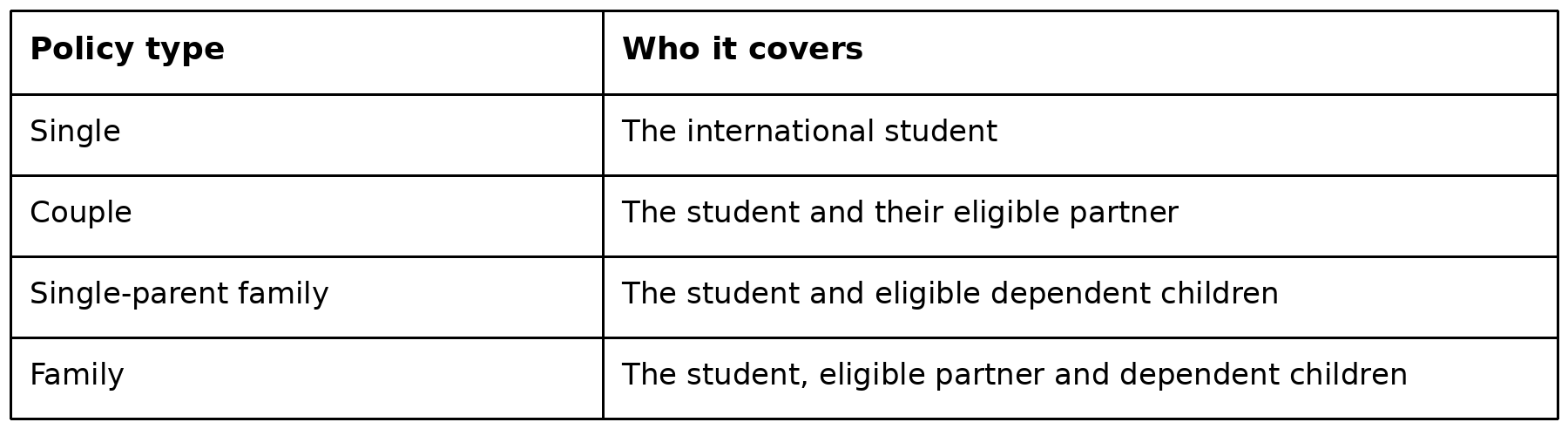
The actual premium should be obtained directly from the insurer for the required dates and membership category.
How Can Indian Students Compare OSHC Prices?
Before purchasing a policy, students should:
- Visit the websites of approved OSHC providers.
- Enter their intended arrival date and required coverage duration.
- Select the correct membership category.
- Compare basic and additional cover options.
- Review the policy benefits, exclusions and waiting periods.
- Check the final premium and payment conditions.
Avoid selecting a policy based only on the lowest price. A cheaper policy may have different benefits, provider networks or limits that affect how much you pay when accessing healthcare.
Which Are the Approved OSHC Providers in Australia?
International students must purchase OSHC from an approved Australian health insurer.
The Australian Government's current OSHC information identifies five insurer groups, with ahm operating as part of Medibank.
The available OSHC brands are:
- Allianz Care Australia: Offers OSHC products for international students, with different coverage options and support services.
- Bupa Australia: Provides OSHC policies with medical and hospital benefits, alongside optional additional coverage.
- CBHS International Health: Offers health insurance options designed for international students and other eligible overseas visitors.
- Medibank and ahm OSHC: Both brands offer OSHC products for international students. ahm is part of the Medibank group.
- nib OSHC: Provides OSHC policies with different benefit arrangements and services for overseas students.
How Should Students Choose an OSHC Provider?
There is no single provider that is automatically the best option for every student.
Consider the following when comparing policies:
- Total premium for the required coverage period.
- GP and specialist medical benefits.
- Hospital treatment arrangements.
- Prescription medicine limits.
- Emergency ambulance benefits.
- Direct-billing clinic networks.
- Digital membership cards and claim facilities.
- Additional coverage options.
- Customer support and complaint-handling procedures.
Students should also read the insurer's Product Disclosure Statement (PDS) and policy information before making a decision.
OSHC for Dependants Australia: Does Your Family Need Insurance?
International students who have eligible family members included in their Student visa arrangements must ensure that those family members have adequate health insurance.
Depending on the family circumstances, students may need a different membership category instead of single OSHC.
The available policy categories generally include:
- Single cover: For the student only.
- Couple cover: For the student and eligible spouse or partner.
- Single-parent family cover: For the student and eligible dependent children.
- Family cover: For the student, eligible partner and dependent children.
For example, an Indian student travelling with an eligible spouse may need couple cover rather than a single policy.
Students should not assume that an existing single policy automatically covers a family member added to their immigration arrangements.
Importantly, Australian Student visa rules governing the inclusion of family members can change. Students should confirm whether their family members are eligible to be included in their visa application before arranging family OSHC. For further information, students can also read about Australia student visa dependant changes.
How Long Should OSHC Coverage Last?
The OSHC policy duration must meet the Australian Student visa health insurance requirements.
Students should arrange coverage for the required period of their stay, rather than purchasing insurance only for the duration of their academic classes.
The required period depends on the visa grant and the student's circumstances.
For example, a student enrolling in a two-year postgraduate programme should not automatically assume that a 24-month policy will be sufficient. The required insurance dates may extend beyond the course end date.
Before purchasing OSHC, check:
- The expected date of arrival in Australia.
- The course commencement and completion dates.
- The expected Student visa period.
- Any additional period required under the visa arrangements.
- Whether the policy dates match the intended stay.
Students should use the current Department of Home Affairs guidance on Student visa grant periods to determine the required insurance duration.
When Should OSHC Start for Indian Students?
This is one of the most important details to check before travelling.
For students applying for their Student visa from outside Australia, OSHC must begin on the date they arrive in Australia, not simply on the date their course starts.
For example:
An Indian student has a course commencement date of 20 February 2027 but plans to arrive in Australia on 5 February 2027.
In this situation, the OSHC policy should begin on 5 February 2027.
The student should not enter Australia before the insurance coverage becomes active.
Students already in Australia applying for a further Student visa must also ensure that their insurance arrangements meet the continuity requirements.
What Happens If OSHC Expires Before the Student Leaves Australia?
Students must maintain adequate health insurance while holding a Student visa.
If a policy expires before the required stay ends, the student should arrange renewal or replacement cover without a break.
A lapse in insurance can create problems with visa compliance and leave students responsible for medical expenses.
Set a reminder well before the policy expiry date and keep the insurance certificate and payment records accessible.
How to Buy OSHC in Australia: A Step-by-Step Guide
Indian students can arrange OSHC directly through an approved insurer or through an education provider or authorised agent.
The process is straightforward when the required dates and personal details are available.
Step 1: Confirm Your Insurance Requirements
Check your intended arrival date, Student visa details and required coverage duration.
Step 2: Choose an Approved Provider
Compare the available providers and select an insurer offering a policy that meets your needs.
Step 3: Select the Correct Membership Type
Choose single, couple, single-parent or family cover according to the eligible people who require insurance.
Step 4: Compare Benefits and Premiums
Review medical benefits, hospital arrangements, pharmaceutical limits, exclusions and optional extras.
Step 5: Purchase the Policy
Complete the application and payment through the insurer or an authorised arrangement.
Step 6: Receive Your OSHC Certificate
Keep the insurance certificate and policy number. These details may be required when completing your Student visa application.
Step 7: Check Your Coverage Before Travelling
Confirm that the start and end dates are correct and that the policy is active before entering Australia.
How Can Students Use OSHC After Arriving in Australia?
Purchasing OSHC is only the first step. Students should also understand how to access medical services and claim insurance benefits after reaching Australia.
Here are some practical steps.
1. Activate Your Membership
Follow the insurer's instructions to access your membership account, digital card or mobile application.
2. Find a GP
A General Practitioner is usually the first point of contact for non-emergency medical concerns.
Check whether the clinic offers direct billing through your OSHC provider.
3. Check Treatment Costs Before Appointments
Ask the clinic how much the consultation will cost and confirm how much your insurer is likely to pay.
This helps you understand any potential gap fee.
4. Understand the Claim Process
Depending on the provider and clinic, the insurer may pay the medical provider directly, or you may need to pay first and submit a claim for reimbursement.
Keep invoices and receipts until your claim is processed.
5. Know What to Do in an Emergency
For an emergency in Australia, call 000 or attend an emergency department.
Do not delay emergency treatment while trying to confirm insurance benefits. Contact your insurer when it is practical to do so.
Students preparing for their first few weeks in Australia can also refer to the first 13 things international students must do in Australia.
Can Students Change Their OSHC Provider?
Yes. International students can generally change their OSHC provider during their studies.
However, students must ensure that their replacement policy meets the required insurance conditions and that there is no gap between the old and new policies.
Before switching, check:
- The new policy's commencement date.
- The benefits and exclusions.
- Any applicable waiting periods.
- Refund or transfer arrangements with the existing insurer.
- Whether the new provider has received all the information needed to activate the policy.
Do not cancel the existing policy until the replacement coverage arrangements are confirmed.
Common OSHC Mistakes Indian Students Should Avoid
Even when students purchase insurance, mistakes in policy selection and timing can cause unnecessary expenses or compliance issues.
Here are some common problems to avoid.
1. Choosing insurance based only on price
A lower premium does not necessarily mean the policy offers the most suitable benefits.
2. Starting insurance on the course commencement date
Students travelling before their course starts must ensure their OSHC begins on their arrival date.
3. Purchasing insufficient coverage
Check the required insurance duration against the expected Student visa period.
4. Assuming dental treatment is included
Routine dental treatment is generally excluded from basic OSHC.
5. Ignoring gap fees
The insurer may pay only a specified benefit amount, leaving students responsible for the difference.
6. Forgetting dependant coverage
Students travelling with eligible family members must select the correct policy category.
7. Allowing insurance to expire
Maintain continuous coverage and renew the policy before its expiry date.
8. Not reading the policy conditions
Check waiting periods, annual benefit limits, exclusions and claim procedures before purchasing.
What Should Indian Students Check Before Travelling to Australia?
Use this checklist to review your OSHC arrangements before departure.
- Purchased insurance from an approved OSHC provider.
- Selected the correct membership category.
- Confirmed the policy start date matches the planned arrival date.
- Checked the required coverage duration.
- Included eligible family members where applicable.
- Received the OSHC certificate and policy details.
- Reviewed medical benefits and exclusions.
- Checked prescription medicine limits and additional costs.
- Saved the insurer's contact information.
- Downloaded the membership card or mobile application.
Keeping these details ready can make it easier to access medical services after arriving in Australia.
Conclusion
OSHC is an essential part of preparing to study in Australia. For Indian students, it is generally a mandatory Student visa requirement that provides financial assistance towards eligible medical treatment, hospital services, emergency ambulance transport and certain prescription medicines.
Before purchasing a policy, check more than just the premium. Compare approved insurers, understand the difference between basic and additional coverage, review exclusions and benefit limits, and confirm the correct policy duration. Most importantly, students travelling from India must ensure their insurance starts on their planned arrival date and remains active throughout their required stay.
Understanding these requirements before departure can help prevent unexpected medical expenses and avoid unnecessary insurance compliance problems. If you are still preparing your Australian university application or visa documents, getting the right guidance at the planning stage can make the process easier.
Hola World supports students with Australian course selection, admissions, visa guidance and pre-departure preparation. You can also connect with the best study abroad consultants in Kerala to discuss your study plans and understand the steps involved in preparing for Australia. A well-planned move includes not only securing admission but also being ready for healthcare, accommodation and everyday life after arrival.
If you need guidance with Australian course selection, admissions or visa preparation, book a free consultation to discuss your study plans.
Frequently Asked Questions
1. Is OSHC compulsory for Indian students in Australia?
Yes. Indian students applying for an Australian Student visa (subclass 500) generally need OSHC from an approved Australian insurer. They must maintain adequate coverage for the required period of their stay.
2. How much does OSHC cost for Indian students?
The cost depends on the provider, policy duration, membership type and selected benefits. Students should obtain current quotations directly from approved insurers rather than relying on a fixed annual price.
3. Can Indian students choose their own OSHC provider?
Yes. Students can generally select any approved OSHC insurer that meets Australian Government requirements. They are not required to accept their university's recommended provider.
4. Does OSHC cover dental treatment?
Basic OSHC generally does not cover routine dental treatment. Some insurers offer additional cover that includes selected dental services for an extra premium.
5. Does OSHC cover prescription medicines?
Yes. Basic OSHC includes limited pharmaceutical benefits. Annual limits and per-item caps apply, so students should check their insurer's policy conditions.
6. Does OSHC cover mental health treatment?
Some mental health services may receive benefits under OSHC, depending on the treatment, referral requirements and policy conditions. Students should confirm their eligibility and benefits with their insurer before booking treatment.
7. Can I purchase OSHC after arriving in Australia?
Students applying from outside Australia must have OSHC starting from their arrival date. They should purchase and activate their insurance before travelling rather than waiting until they arrive.
8. Do my spouse and children need OSHC?
Eligible family members included in the Student visa arrangements must have adequate health insurance. Students should select the appropriate couple or family policy based on their circumstances.
9. Can I use Medicare instead of OSHC?
Most Indian international students are not eligible for Medicare. Medicare eligibility and reciprocal healthcare arrangements are separate from the general OSHC requirement, so Indian students should arrange OSHC.
10. Can I change my OSHC provider during my course?
Yes. Students can generally change insurers, provided they maintain adequate and continuous cover. They should confirm the new policy's start date before ending the existing policy.
11. What happens if I do not maintain OSHC?
Failing to maintain adequate health insurance can put a Student visa holder in breach of visa condition 8501. It can also leave the student responsible for medical and hospital expenses that would otherwise receive insurance benefits.
12. Is OSHC the same as travel insurance?
No. OSHC is designed to meet the health insurance requirements for international students in Australia. Travel insurance is a separate product that may cover matters such as travel disruptions, baggage loss and other travel-related risks. One does not automatically replace the other.