How to Choose the Right University for Your Master's in the UK: 2027 Admission Essentials
25 Nov, 2026

Planning to study a master's degree in the UK in 2027? Choosing the right university and course is one of the most important decisions you will make. With hundreds of universities offering postgraduate programmes across different subjects, finding the right option can feel confusing. You may be wondering whether your bachelor's degree is suitable, what percentage you need, which universities accept Indian qualifications, how much the course will cost and when you should apply.
The UK remains an attractive destination for Indian students because many full-time taught master's programmes can be completed in just one year. However, a shorter course does not mean you should rush your decision. Your choice of university, course structure, academic background, budget and future career plans all matter.
This guide to UK Master's Admission 2027 explains how to shortlist universities, compare courses, understand entry requirements, prepare your application and plan for your Student visa. It also highlights important immigration changes relevant to students starting in 2027, so you can make decisions with a clearer understanding of what lies ahead.Students looking for guidance can also connect with the best study abroad consultants in Kerala for support with their study abroad plans.
Why Study a Master's Degree in the UK in 2027?
The UK offers a wide range of postgraduate qualifications, including MA, MSc, MBA, LLM and specialised professional master's programmes.
For Indian students, some of the main reasons to consider the UK include:
- Shorter study duration: Many full-time taught master's degrees take one year, although some courses are longer.
- Specialised programmes: Universities offer courses in areas such as business, engineering, healthcare, computing, finance, law and social sciences.
- International learning environment: Students study alongside people from different academic and professional backgrounds.
- Research opportunities: Many universities have established research facilities and industry partnerships.
- Career development: Some programmes include placements, practical projects, internships or industry-based assignments.
- International qualification: A UK master's can provide academic and professional opportunities in different countries, depending on the qualification and relevant professional recognition.
A one-year programme can reduce the time spent away from employment compared with a two-year degree. However, the overall value depends on the course, university, total expenses and career opportunities after graduation.
How to Choose the Right UK University for 2027
Choosing a university based only on its ranking is not always the best approach. A highly ranked university may not offer the most suitable course for your academic background or career plans.
Instead, consider the following factors before shortlisting universities.
1. Check the University's Reputation and Recognition
Start by checking whether the university is a recognised UK higher education institution and whether the qualification meets your academic and professional goals.
You can research universities using QS World University Rankings, Times Higher Education World University Rankings and subject-specific university rankings.
Rankings can help you understand a university's overall reputation, but they should not be the only deciding factor. A university with a lower overall ranking may have a particularly strong department in your chosen subject.
Also check professional accreditation if you are applying for a regulated or professionally oriented course. Some engineering, accounting, management and healthcare qualifications have specific accreditation or recognition requirements.
Before accepting an offer, check whether the institution awarding your degree is officially recognized in the relevant part of the UK. Remember that the institution delivering your course and the institution awarding your qualification may be different.
2. Compare the Course Curriculum
Two universities may offer an MSc in Data Science, but the modules and learning outcomes can be very different.
Before applying, review:
- Core and optional modules.
- Practical and research components.
- Dissertation requirements.
- Laboratory or technical facilities.
- Industry projects.
- Placement opportunities.
- Assessment methods.
For example, a student interested in a career in data analytics may prefer a course covering machine learning, statistical modelling, programming and business analytics rather than a programme focused mainly on theoretical research.
Read the complete course description rather than relying only on its title.
3. Consider Location and Living Expenses
The location of a university can significantly affect your overall budget.
London offers access to a large number of businesses, professional networks and cultural opportunities. However, accommodation and daily expenses can be higher.
Universities in cities such as Manchester, Birmingham, Leeds, Sheffield, Glasgow and Nottingham may offer different combinations of tuition costs, accommodation options and employment opportunities.
When comparing locations, consider accommodation costs, public transport, food and personal expenses, distance from campus, part-time employment opportunities and the availability of student accommodation.
Do not choose a university simply because the city appears cheaper. Check the actual accommodation options and travel expenses before making a decision.
4. Check International Student Support
International student support can make a considerable difference, especially when moving abroad for the first time.
Look for universities that provide:
- Dedicated international student offices.
- Academic and language support.
- Career guidance.
- Accommodation assistance.
- Orientation programmes.
- Wellbeing and student support services.
Also check how the university supports students who need help with academic progression, attendance or other course-related concerns.
Popular Master's Courses to Consider in the UK for 2027
The right course depends on your undergraduate qualification, interests and intended career direction. The following are examples of popular postgraduate study areas.
Nursing
Students with relevant nursing qualifications and professional backgrounds may consider:
- MSc Clinical Nursing.
- MSc Advanced Nursing Science.
- MSc Advancing Nursing Science.
These programmes focus on developing nursing knowledge, clinical practice, research and leadership skills. Entry requirements vary, and some programmes require applicants to be registered nurses with relevant professional experience.
Healthcare and Public Health
Depending on their academic and professional backgrounds, students may consider:
- MSc Public Health.
- MSc Health Management.
- MSc Healthcare Leadership.
- MSc Global Health.
Some healthcare-related courses have specific professional or subject requirements.
Computer Science and Analytics
Students with backgrounds in computer science, IT, mathematics or related subjects may consider:
- MSc Computer Science.
- MSc Data Science.
- MSc Cyber Security.
- MSc Artificial Intelligence.
- MSc Software Engineering.
Check whether the course requires programming knowledge, mathematics or previous technical study.
Students with relevant backgrounds in mathematics, statistics, computing or business may consider:
- MSc Business Analytics.
- MSc Applied Data Science.
- MSc Data Analytics.
- MSc Financial Analytics.
These programmes can combine analytical methods with practical applications in business and industry.
Finance and Accounting
Graduates in commerce, accounting, economics and finance may consider:
- MSc Finance.
- MSc Accounting and Finance.
- MSc Financial Management.
- MSc International Banking.
- MSc Business Analytics.
Check the quantitative and academic requirements before applying.
Law and Social Sciences
Students with relevant academic backgrounds may consider:
- LLM International Law.
- LLM Commercial Law.
- MA International Relations.
- MA Education.
- MA Communication Studies.
- MA Social Work.
- MSc Social Work.
- Master of Social Work (MSW).
Always check whether a particular programme requires a law degree or accepts applicants from other academic disciplines. Social Work programmes may have specific academic and practical experience requirements.
Business and Management
Students with backgrounds in business, commerce and management may consider:
- MSc Management.
- MSc International Business.
- MBA.
- MSc Human Resource Management.
- MSc Marketing Management.
These programmes can cover business strategy, organisational management, leadership, marketing and international business operations.
UK Master's Entry Requirements for Indian Students in 2027
One of the most important parts of UK Master's Admission 2027 is understanding how universities assess Indian bachelor's degrees.
Most universities consider your undergraduate qualification, academic performance, subject relevance and English-language ability. However, admission requirements differ between universities and even between courses at the same institution.
1. Academic Qualification
Generally, international applicants need a recognised bachelor's degree from an appropriate institution.
Depending on the programme, universities may accept:
- Three-year bachelor's degrees.
- Four-year bachelor's degrees.
- Relevant professional qualifications, where accepted.
- Related postgraduate or professional qualifications.
Some universities require applicants to have studied a particular subject at undergraduate level. Others may accept graduates from different disciplines.
2. Percentage or CGPA Requirements
UK universities commonly use degree classifications such as First-Class Honours, Upper Second-Class Honours (2:1) and Lower Second-Class Honours (2:2).
Indian degree percentages and CGPA scores are assessed according to each university's equivalency policy.
As a general illustration, some universities may consider approximately 60% or above for courses requiring a UK 2:1, while certain courses requiring a 2:2 may consider approximately 55% or above. These figures are not universal admission standards.
The required score can depend on:
- Your Indian university.
- The grading system used.
- The course you are applying for.
- The classification required by the department.
- Your overall academic profile.
For example, the University of Sheffield's published Indian qualification guidance associates a 60% score with a 2:1 and 55% with a 2:2 for relevant qualifications. However, requirements can vary according to the institution awarding the degree and the individual course.
Therefore, do not assume that a particular percentage guarantees admission to every UK university.
3. English Language Requirements
International students must demonstrate the required level of English for their course and, where applicable, their Student visa.
Universities may accept recognised English-language tests such as:
- IELTS Academic.
- PTE Academic.
- TOEFL iBT.
- Other approved tests or university-specific assessments.
Some universities may accept previous English-medium education or other evidence, depending on their policies and the applicable immigration requirements.
For degree-level study under the UK Student route, the immigration English requirement is generally equivalent to CEFR level B2. An eligible higher education provider with the appropriate sponsor status may assess English proficiency itself.
However, individual courses can have higher requirements, particularly where strong communication skills are essential.
English-language requirements for university admission and Student visa applications are not always identical. Students should check whether their chosen university accepts their English-language evidence and whether it also meets the applicable UK immigration requirements.
Important: Do not assume that every university accepts the same IELTS score or that a medium-of-instruction certificate will automatically meet the Student visa requirement. Check the university's policy and the visa requirements separately.
4. Work Experience
Work experience is not compulsory for every master's programme.
However, it may be required or preferred for particular courses, especially:
- MBA programmes.
- Executive management courses.
- Specialist professional programmes.
- Certain healthcare and leadership qualifications.
If you have relevant professional experience, include it in your application where it strengthens your suitability for the programme.
Documents Required for UK Master's Admission
Preparing your documents early can help prevent delays during the application process.
Most universities may request:
- Academic transcripts: Show your subjects, marks and academic performance.
- Degree certificate or provisional certificate: Confirms your undergraduate qualification.
- Passport: Establishes your identity and nationality.
- CV or resume: Summarises education, employment and relevant experience.
- Statement of Purpose: Explains your academic interests and reasons for choosing the course.
- Letters of recommendation: Provide academic or professional references.
- English-language test result: Demonstrates language proficiency, where required.
- Work experience documents: Support applications where experience is relevant.
- Portfolio or additional assessment: Required for selected creative or specialist courses.
If you are still completing your bachelor's degree, you may be able to apply using available semester transcripts or predicted results, depending on the university's policy.
You may receive a conditional offer requiring you to submit your final results or outstanding documents before enrolment.
How to Apply for a Master's in the UK in 2027
Unlike undergraduate applications through UCAS, most postgraduate taught master's applications are submitted directly to the university through its application portal.
The process generally follows these steps.
Step 1: Assess Your Academic Profile
Review your bachelor's degree, marks, subject background, backlogs if any, work experience and English-language qualifications.
This helps identify programmes for which you are academically eligible. Students planning to pursue a master's degree in the UK can find suitable courses and universities with the support of the best education consultants to study abroad in UK.
Step 2: Shortlist Suitable Universities
Select universities based on academic requirements, course modules, tuition fees, location, career opportunities, scholarship availability and application deadlines.
It is sensible to compare a range of universities rather than relying on one option.
Step 3: Prepare Your Application Documents
Prepare your transcripts, certificates, CV, statement of purpose, references and English-language evidence.
Make sure the information is consistent across all documents.
Step 4: Submit Applications
Apply through the university's official postgraduate application portal or its authorised application route.
Check whether an application fee applies and whether additional documents are required.
Step 5: Receive and Review Your Offer
You may receive a conditional offer, an unconditional offer, a request for additional information or an unsuccessful application decision.
If you receive a conditional offer, understand exactly what you must provide and by when.
Step 6: Meet the Offer Conditions and Arrange Your Deposit
Once you meet the academic and other conditions, follow the university's instructions regarding fee deposits and acceptance.
Check the refund policy before making payments.
Step 7: Complete Your CAS and Student Visa Process
After completing the required university procedures, your institution may issue a Confirmation of Acceptance for Studies (CAS).
You can then prepare your Student visa application, financial evidence and any other required documents.
When Should You Apply for a UK Master's in 2027?
Planning early is important because popular courses may fill their available places before the final application deadline.
For September 2027 entry, it is sensible to start researching and preparing your application well in advance.
A practical planning schedule is:
- November–December 2026: Research courses, assess eligibility and shortlist universities.
- January–February 2027: Prepare documents and submit applications.
- March–April 2027: Review offers, meet conditions and compare costs.
- May–June 2027: Confirm your university, arrange finances and complete required procedures.
- June–August 2027: Complete CAS and visa preparations, arrange accommodation and travel.
- September 2027: Begin your master's programme.
This is a suggested planning schedule, not a universal university deadline. Some universities accept applications earlier or later, while competitive courses and scholarship applications may have separate deadlines.
For example, the University of Leeds' published application information for 2027/28 master's entry states that applications opened on 1 October 2026. Its general guidance gives 30 July 2027 as a typical international application deadline, although individual courses may close earlier.
Always follow the deadline published for your chosen programme.
What about January 2027 entry?
January 2027 is approaching, so students who have not yet applied should first check whether their preferred universities and courses are still accepting applications. Some programmes may already have closed or may not offer a January intake. Admission, CAS and visa processing also take time, so availability should be confirmed directly with the university.
Students who have not completed their application preparations may find September 2027 a more practical intake to consider.
How Much Does It Cost to Study a Master's in the UK in 2027?
The total cost depends on the university, course, city, accommodation and lifestyle.
The British Council's Study UK guidance gives an indicative international postgraduate tuition range of approximately £9,000–£30,000. Specialist programmes and some highly ranked universities may charge more.
Your budget should include:
- University tuition fees.
- Accommodation.
- Food and daily expenses.
- Local transport.
- Books and study materials.
- Visa application charges.
- Immigration Health Surcharge.
- Travel expenses.
- Personal and emergency funds.
Do not compare universities using tuition fees alone. A lower tuition fee may not necessarily mean a lower overall cost if accommodation and living expenses are significantly higher.
UK Student Visa Financial Requirements
Students applying for a UK Student visa generally need to demonstrate that they can pay their outstanding course fees and meet the applicable living-cost requirement.
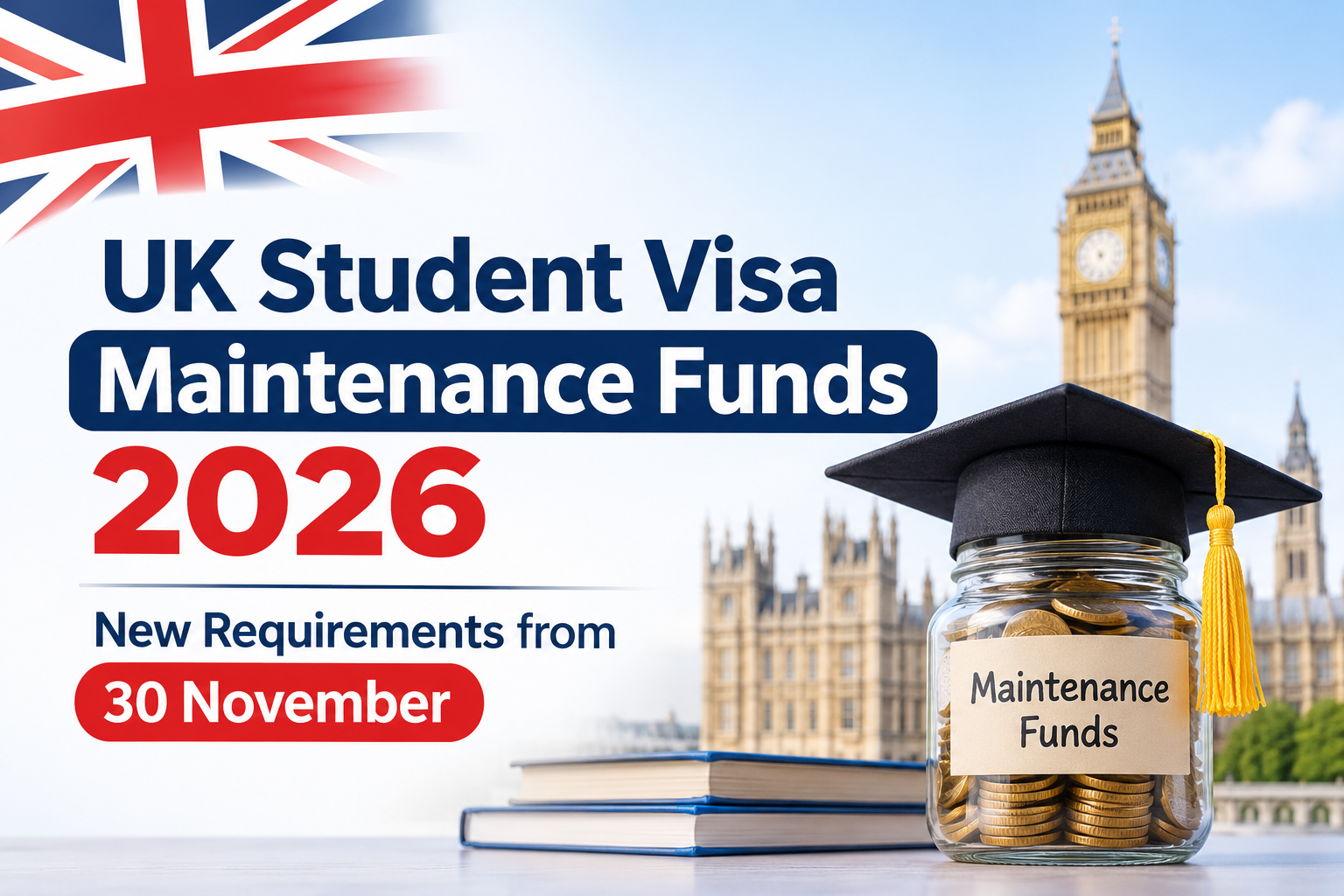
For applications submitted up to 29 November 2026, the published monthly maintenance requirements are:
- London: £1,529 per month.
- Outside London: £1,171 per month.
However, under the Home Office's Statement of Changes to the Immigration Rules (HC 584), these amounts increase for applications submitted on or after 30 November 2026:
- London: £1,570 per month, up to £14,130 for nine months.
- Outside London: £1,203 per month, up to £10,827 for nine months.
These amounts are separate from outstanding tuition fees. Students generally need to hold the required funds for 28 consecutive days, with the end of that period falling within 31 days of their visa application, subject to applicable exemptions and alternative evidence rules.
For students applying in 2027, the increased maintenance amounts are the relevant figures under the rules currently in force.
Important: Always check the financial requirements in force on your actual visa application date rather than relying on older figures.
Scholarships for Indian Students Applying for a UK Master's in 2027
Scholarships can reduce the financial burden of postgraduate study, but availability and eligibility differ between universities and funding organisations.
University Scholarships
Many UK universities offer international postgraduate scholarships based on academic achievement, subject area, nationality or financial circumstances.
These may include merit-based tuition fee reductions, international student scholarships, department-specific awards and country-specific scholarships.
Check the scholarship conditions carefully. Some awards are automatically considered with your course application, while others require a separate application.
Chevening Scholarships
Chevening is a UK government scholarship programme that supports eligible applicants pursuing a one-year master's degree in the UK.
It is competitive and has specific eligibility, leadership and work-experience requirements. Applicants generally need at least two years of eligible work experience, equivalent to 2,800 hours, along with the other eligibility conditions.
Applicants must also meet the scholarship's post-study return requirement. Check the official Chevening website for the relevant application cycle and deadlines.
GREAT Scholarships
The GREAT Scholarships programme supports eligible students from participating countries through selected UK universities and courses.
Availability, award amounts and participating institutions can change each academic year. The awards announced for 2026/27 should not be assumed to apply to 2027/28.
Important: Scholarship availability, award amounts and application deadlines for the 2027/28 academic year may differ from previous cycles. Students should check the official scholarship announcements and university websites before making financial plans.
Do not finalise your university budget assuming that you will receive a scholarship. Treat an award as confirmed only after receiving official notification.
UK Student Visa Requirements for Master's Students in 2027
Receiving an admission offer is not the final step. International students who need immigration permission must also meet the requirements of the UK Student route.
The main requirements generally include:
- An unconditional offer for an eligible course.
- A valid CAS from a licensed Student sponsor.
- Required financial evidence.
- English-language evidence, where applicable.
- A valid passport.
- ATAS clearance if your course and nationality require it.
- Tuberculosis test evidence if applicable to your circumstances.
The Student visa application fee for applications made outside the UK is £558 under the fee schedule in force as of November 2026. Students must also pay the Immigration Health Surcharge, currently £776 per year for students. The total surcharge depends on the length of immigration permission granted.
These are current published figures, not guaranteed 2027 application costs. Check for any fee changes before applying.
Tuberculosis Test and ATAS Requirements
Indian students applying for a UK visa for a stay longer than six months will generally need a TB test if they meet the Home Office residence conditions. The test must be completed at a Home Office-approved clinic.
ATAS clearance is required only for certain sensitive subject areas and nationalities. Not every international master's student needs it. Check the official ATAS requirements before applying if your course falls within a subject area covered by the scheme.
Can Master's Students Work While Studying?
Eligible full-time degree-level students sponsored by a higher education provider with a track record of compliance can generally work up to 20 hours per week during term time and full-time during official vacation periods.
However, restrictions apply to certain activities and types of employment. Your actual work conditions are stated on your immigration permission.
Do not plan your tuition or living expenses on the assumption that part-time employment will cover all your costs.
Can You Bring Dependant to the UK?
Not every international master's student can bring family members as dependant.
Under the current Student route rules, students starting postgraduate courses on or after 1 January 2024 generally qualify to bring dependant only if they are studying a PhD or another doctoral qualification, or an eligible research-based higher degree.
A government-sponsored student on a qualifying course lasting at least six months may also qualify under the applicable rules.
For postgraduate courses starting on or after 1 January 2024, a research-based higher degree generally means a postgraduate programmes where the research component is larger than the taught component in terms of student effort.
A standard taught MSc or MA does not normally qualify for the dependant route simply because it is a postgraduate qualification.
Check the precise course classification and current immigration rules before making family travel plans.
Important 2027 Update: UK Graduate Route Visa Duration
One important confirmed immigration change that prospective master's students should understand is the reduction in the Graduate visa period from 1 January 2027.
Under the confirmed immigration rules:
- Eligible graduates applying for the Graduate visa on or before 31 December 2026 can receive two years of permission.
- Eligible graduates applying on or after 1 January 2027 will receive 18 months if they completed a bachelor's or master's degree.
- PhD and other doctoral graduates continue to qualify for three years.
This change is based on the date of the Graduate visa application, not simply the date you start your master's course.
For example, a student beginning a one-year master's in September 2027 would normally complete the course in 2028. If eligible and applying after successful completion, the Graduate visa period would be 18 months under the rules currently in force.
The Graduate Route is not automatic. Students must meet the eligibility requirements, successfully complete an eligible course and apply at the appropriate time.
This is particularly important when comparing the UK with other study destinations. Consider your career plans, likely employment sector and longer-term immigration options rather than choosing a university based only on the availability of post-study work permission.
Common Mistakes to Avoid When Applying for a UK Master's
A well-prepared application can help you avoid unnecessary delays and unsuitable course choices.
Watch out for these common mistakes:
- Choosing a university only by ranking: Check the course structure, academic requirements and career relevance.
- Applying without checking subject relevance: Some master's courses require a specific undergraduate background.
- Assuming every university accepts the same percentage: Grade equivalencies differ across institutions.
- Ignoring English-language conditions: Check the university's requirements and Student visa rules separately.
- Applying too close to the deadline: Competitive courses may stop accepting applications earlier.
- Underestimating the budget: Include tuition, accommodation, visa costs and living expenses.
- Relying on scholarships before receiving confirmation: Keep a realistic financial plan.
- Misunderstanding Graduate Route changes: Factor the 18-month period for applications made from January 2027 into your career planning.
How Hola World Can Help With UK Master's Admission 2027
Choosing a postgraduate course involves more than finding a university that offers admission. You need to understand how your previous education matches the course, whether you meet the academic requirements, what the programme offers and whether the overall plan fits your budget and career goals.
Hola World provides personalized study abroad support, helping students assess their academic profiles and identify suitable universities and courses. Our approach focuses on understanding each student's background and goals before recommending options. As overseas education consultants in Kerala, we support students through different stages of their international education journey.
Our support includes:
- Individual academic profile assessment.
- Course and university selection.
- Eligibility assessment.
- Application and documentation support.
- Offer evaluation and admission assistance.
- Student visa documentation and application assistance.
- Pre-departure support and continued assistance.
If you are planning to apply for a master's degree in the UK for 2027, an early eligibility assessment can help you identify suitable courses and prepare a realistic application plan.
Frequently Asked Questions About UK Master's Admission 2027
1. When should I apply for a master's in the UK for September 2027?
Ideally, begin researching universities and preparing documents several months before your intended intake. Applications for some 2027 programmes are already open. Apply early because competitive courses and scholarships may have earlier deadlines.
2. Can Indian students apply for a UK master's with 50% marks?
Some universities and courses may consider applicants with lower undergraduate scores, but many programmes require a higher percentage. Eligibility depends on your university, degree classification, subject background and course requirements.
3. Is a three-year bachelor's degree accepted for a UK master's?
Yes. Many UK universities accept recognised three-year Indian bachelor's degrees for postgraduate admission. However, the university must assess your qualification against its country-specific and course-specific requirements.
4. Can I study for a master's in the UK without IELTS?
Some universities accept alternative English-language evidence, such as an approved previous qualification taught in English or an internal assessment. However, acceptance depends on the university's policy and the applicable Student visa requirements.
5. How long does a master's degree take in the UK?
Many full-time taught master's programmes take one year. Some courses, including research-based programmes and certain specialist degrees, may take longer.
6. Can I change my field for a master's in the UK?
Yes, some programmes accept students from different undergraduate backgrounds. However, technical, scientific and professionally specialised courses may require relevant previous education or experience.
7. Do I need work experience for a UK master's?
Not for every course. Many MSc and MA programmes accept recent graduates. However, some MBA and professional master's programme require or prefer relevant work experience.
8. Can I work while studying for my master's in the UK?
Eligible full-time degree-level students can generally work up to 20 hours per week during term time and full-time during official vacations. Always follow the conditions stated on your Student visa.
9. Can I bring my spouse to the UK while studying for a master's?
Most students enrolled in standard taught master's programmes cannot bring dependant under the current rules. Exceptions generally apply to eligible doctoral or research-based higher degrees and certain government-sponsored students.
10. What is the Graduate visa duration for students graduating in 2027?
For eligible bachelor's and master's graduates applying on or after 1 January 2027, the Graduate visa lasts 18 months. Eligible doctoral graduates can receive three years.
11. Is a September or January intake better for a UK master's?
Both can be suitable, depending on course availability and your application readiness. September generally offers a wider choice of courses, while January provides an alternative for students who need additional preparation time. However, not every course is available in both intakes.
12. Can I apply for a UK master's while waiting for my final bachelor's results?
Many universities allow applications using available transcripts or predicted results. They may issue a conditional offer requiring you to submit your final results before enrolment and CAS issuance.
13. How many universities should I apply to for a UK master's?
There is no fixed number. A practical approach is to shortlist several universities that match your academic profile, budget and career plans. Focus on suitable choices rather than submitting applications to a large number of unrelated courses.
Conclusion: Plan Your UK Master's Admission for 2027 Carefully
Studying for a master's degree in the UK in 2027 can be a valuable opportunity, but choosing the right university and course requires careful planning. Start by understanding your academic profile, identifying suitable subjects and comparing universities based on course content, entry requirements, tuition fees, location and career relevance.
Do not make your decision based only on university rankings or admission offers. Check the complete course requirements, prepare your documents early, understand the financial commitment and stay informed about the latest Student visa and Graduate Route rules.
For Indian students, particularly those applying from Kerala, an early assessment can help identify realistic university options and avoid unnecessary application delays. Having the right support throughout the admission process can make it easier to understand your eligibility, compare suitable courses and prepare your application.
If you are considering a September 2027 intake, start preparing now. You can book a free consultation with Hola World to discuss your academic profile, identify suitable master's programme and plan your next steps.