New Zealand Short-Term Graduate Work Visa 2026: Eligibility, Requirements and Application Guide
10 Nov, 2026
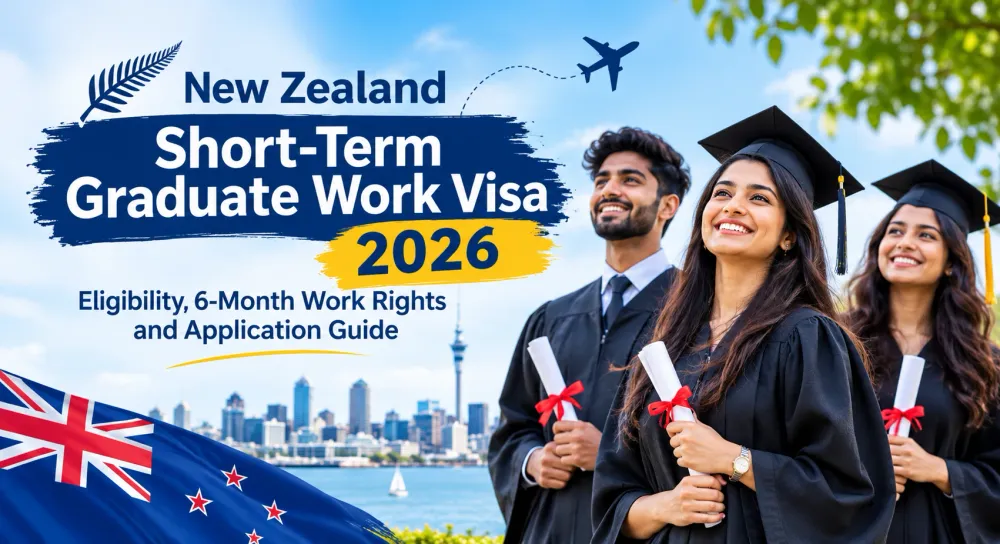
New Zealand is introducing a new work visa option for international graduates, giving eligible students an additional opportunity to gain work experience after completing their studies. The New Zealand Short-Term Graduate Work Visa will open for applications on 16 November 2026, offering up to six months of open work rights to graduates who do not qualify for the existing Post-Study Work Visa.
This announcement is particularly relevant to international students who complete certain Level 5, Level 6 or Level 7 qualifications but previously had limited options to remain in New Zealand and seek employment after graduation.
The new visa will allow eligible graduates to work for an employer while looking for suitable employment and exploring longer-term work opportunities, including the possibility of transitioning to an Accredited Employer Work Visa (AEWV).
But who can apply? Does the new route benefit Indian students? What are the qualification requirements, financial conditions and application deadlines? And how does it differ from the existing New Zealand Post Study Work Visa?
This guide explains the new immigration pathway, its eligibility requirements, restrictions, application process and what prospective students should consider before choosing a course in New Zealand.
What Is the New Zealand Short-Term Graduate Work Visa?
The New Zealand Short-Term Graduate Work Visa is a new temporary work visa designed for international students who have completed eligible New Zealand qualifications but do not meet the requirements for the standard Post-Study Work Visa.
Under this new immigration pathway, eligible graduates can:
- Stay in New Zealand for up to six months after completing their studies.
- Work in any job for any employer in New Zealand.
- Gain local employment experience.
- Search for suitable employment and explore longer-term work visa options.
- Potentially transition to an Accredited Employer Work Visa if they secure an eligible job offer and meet the relevant requirements.
Immigration New Zealand (INZ) announced that applications will open on 16 November 2026.
One important distinction is that this is not a replacement for the existing Post-Study Work Visa. It is an additional pathway for graduates who would otherwise have limited post-study work opportunities.
The visa is also temporary and cannot be extended. Therefore, students should treat the six-month period as an opportunity to secure suitable employment rather than an automatic route to long-term employment or permanent residence.
New Zealand Short-Term Graduate Work Visa 2026: Key Details
Here is a quick overview of the new visa and its important conditions.
Visa feature | Details |
Visa name | Short-Term Graduate Work Visa |
Application opening date | 16 November 2026 |
Maximum duration | 6 months |
Qualification level | NZQCF Level 5–7 |
Minimum study duration | 24 weeks full-time in New Zealand |
Minimum financial requirement | NZD $5,000 |
Work rights | Open work rights |
Employer requirement | No specific employer required |
Application deadline | Within 3 months of the relevant student visa expiry |
Extension | Not permitted |
Second application | Not permitted |
Previous Post-Study Work Visa holders | Not eligible |
Important: Meeting the qualification requirement alone does not guarantee visa approval. Applicants must also satisfy the financial, health, character and other immigration requirements.
Who Is Eligible for the New Zealand Short-Term Graduate Work Visa?
The new visa is primarily intended for international graduates who have completed an eligible qualification in New Zealand but cannot access the existing Post-Study Work Visa.
To qualify, applicants must meet the following conditions.
1. Complete an Eligible NZQCF Level 5–7 Qualification
Applicants must successfully complete a qualification at Level 5, Level 6 or Level 7 under the New Zealand Qualifications and Credentials Framework (NZQCF).
The qualification must:
- Be completed through full-time study in New Zealand.
- Have a minimum study duration of 24 weeks.
- Not be an English language qualification.
- Not be a foundation or bridging qualification.
- Not be a micro-credential.
- Not already qualify the graduate for a Post-Study Work Visa.
This distinction is important because not every diploma or graduate-level course automatically qualifies.
For example, a student completing an eligible Level 6 diploma after at least 24 weeks of full-time study may qualify if the other visa requirements are met and the qualification does not provide eligibility for a Post-Study Work Visa.
However, a student completing an eligible degree-level qualification that already provides access to the Post-Study Work Visa cannot choose the Short-Term Graduate Work Visa instead.
2. Hold or Have Recently Held a New Zealand Student Visa
Applicants must have held a valid New Zealand student visa within the three months before submitting their application.
The application must be submitted no more than three months after the end date of the student visa associated with the qualification.
This is one of the most important conditions because missing the application window can make a graduate ineligible.
3. Have Sufficient Financial Funds
Applicants must demonstrate that they have access to at least NZD $5,000 to support themselves during their stay.
Immigration New Zealand may request financial evidence, such as:
- Recent bank statements showing the applicant's name.
- Evidence of the available account balance.
- Other acceptable supporting financial documents.
A screenshot of a bank account is not accepted as financial evidence under the published requirements.
4. Meet Health and Character Requirements
Applicants must satisfy New Zealand's health and character requirements.
Depending on their circumstances and intended stay, they may need to provide:
- Medical examination results.
- Chest X-ray certificates.
- Police clearance certificates.
- Additional supporting documents requested by INZ.
5. Meet Additional Scholarship Conditions, If Applicable
Students whose education was supported through the Manaaki New Zealand Scholarship Programme must obtain written approval from the Ministry of Foreign Affairs and Trade or Education New Zealand, as applicable.
This requirement should be checked before submitting an application.
Who Cannot Apply for the New Zealand Short-Term Graduate Work Visa?
Not every international graduate will qualify for this new pathway.
The following applicants are excluded under the published rules:
- Students who completed English language, foundation or bridging qualifications.
- Students whose qualification is a micro-credential.
- Graduates whose qualification already makes them eligible for a Post-Study Work Visa.
- Applicants who have previously received a Short-Term Graduate Work Visa.
- Applicants who have previously been granted a New Zealand Post-Study Work Visa.
- Graduates who fail to apply within the three-month application window.
- Students who cannot meet the financial, health or character requirements.
Another important condition concerns course completion.
If a student does not complete the qualification recorded on their student visa, Immigration New Zealand will not approve the Short-Term Graduate Work Visa application based on that qualification.
Therefore, students should confirm that their actual completed qualification matches the course recorded in their immigration records.
What Work Rights Does the New Visa Provide?
The new visa provides up to six months of open work rights.
Unlike certain employer-specific work visas, applicants do not need to secure a job offer before applying for the Short-Term Graduate Work Visa.
Once approved, they can:
- Work for any employer in New Zealand.
- Take up employment in different job roles.
- Work under an employment agreement or contract for services.
- Search for opportunities that may lead to a longer-term work visa.
However, there are important restrictions.
Can Graduates Start Their Own Business?
No. Short-Term Graduate Work Visa holders cannot own or operate a business under this visa.
Their work must be undertaken for an employer through an employment agreement or a contract for services.
Can Graduates Change Employers?
The visa provides open work rights, so graduates are not restricted to one specific employer. They can explore employment opportunities with different employers during the visa period, subject to the visa conditions.
Can Graduates Apply for Permanent Residency?
The Short-Term Graduate Work Visa does not directly provide permanent residency.
However, graduates may explore other immigration pathways if they obtain qualifying employment and meet the relevant requirements.
For example, an eligible graduate may explore an Accredited Employer Work Visa or another skilled migration pathway depending on their occupation, qualifications, work experience and circumstances.
It is important to understand that holding this temporary visa does not automatically make someone eligible for another work visa or residence visa.
Can You Bring Your Partner or Children on This Visa?
Family visa conditions are an important consideration for international graduates planning to stay in New Zealand.
Under the published rules, Short-Term Graduate Work Visa holders:
- Cannot include their partner or dependent children in their own visa application.
- Cannot support their partner for a work visa based on this visa.
- Cannot support their dependent children for a Dependent Child Student Visa based on this visa.
- May be able to support visitor visa applications for their partner and dependent children.
Family members may also explore separate visa applications if they independently meet the relevant eligibility requirements.
This is different from the standard Post-Study Work Visa, which can provide certain family sponsorship options subject to immigration requirements.
Students planning to move with their families should consider these restrictions before choosing a study and post-graduation pathway.
New Zealand Short-Term Graduate Work Visa vs Post-Study Work Visa
One of the most important questions for international students is how the new visa differs from the existing Post-Study Work Visa.
Both options allow eligible international graduates to remain in New Zealand and work after completing their studies. However, their qualification requirements, duration and long-term opportunities are different.
Comparison | Short-Term Graduate Work Visa | Post-Study Work Visa |
Main purpose | Temporary employment and job search | Post-study employment |
Duration | Up to 6 months | Up to 3 years, depending on qualification |
Qualification levels | Eligible Level 5–7 qualifications | Eligible degree-level and specified non-degree qualifications |
Minimum study period | 24 weeks full-time | Generally 30 weeks for eligible degree-level study |
Job offer required before application | No | No |
Employer restrictions | Open work rights | Depends on qualification and visa conditions |
Business ownership | Not permitted | Certain business ownership is permitted under applicable conditions |
Extension | Not permitted | Subject to visa conditions; not renewable as a second PSWV |
Previous PSWV holders | Not eligible | Not eligible for another PSWV |
The most important difference is the intended graduate group.
The Short-Term Graduate Work Visa addresses students who complete certain qualifications that do not provide access to the standard post-study work route.
Meanwhile, the Post-Study Work Visa continues to offer a longer period of employment for graduates who meet its qualification requirements.
Which visa should you choose?
If your qualification already makes you eligible for a Post-Study Work Visa, that will generally be the more suitable post-study option because it offers a longer period to gain employment experience.
The new Short-Term Graduate Work Visa is particularly relevant if your qualification does not qualify for the standard route.
Important New Zealand Post-Study Work Visa Changes from 16 November 2026
Alongside the introduction of the Short-Term Graduate Work Visa, New Zealand is also expanding eligibility for its existing Post-Study Work Visa.
One significant change concerns students completing a Level 7 Graduate Diploma.
New Eligibility for Level 7 Graduate Diploma Graduates
From 16 November 2026, graduates may qualify for a Post-Study Work Visa if they:
- Successfully complete an NZQCF Level 7 Graduate Diploma.
- Study full-time in New Zealand for the entire duration of the qualification.
- Remain enrolled in the qualification for its full duration.
- Hold a bachelor's degree obtained either in New Zealand or overseas.
There is no specified time limit on when the bachelor's degree must have been awarded.
However, students must complete the Graduate Diploma without relying on cross-crediting or recognition of prior learning to shorten the required study.
How Long Can Graduate Diploma Students Stay?
Eligible Level 7 Graduate Diploma graduates may receive a Post-Study Work Visa for the duration of their Graduate Diploma studies in New Zealand, up to a maximum of one year.
For example:
- A student who completes a six-month eligible Graduate Diploma may receive a visa for up to six months.
- A student who completes a one-year eligible Graduate Diploma may receive a visa for up to one year.
The actual visa duration will depend on the confirmed period of study and the applicant's eligibility.
What About Postgraduate Diplomas and Master's Degrees?
The updated announcement also clarifies the following pathways:
Qualification | Potential Post-Study Work Visa duration |
Eligible Level 8 Postgraduate Diploma | Up to 1 year |
Eligible Level 9 Master's degree | Up to 3 years |
Applicants must generally complete at least 30 weeks of full-time study in the qualification on which their application is based.
For a Master's degree, the required 30 weeks must be completed while enrolled in the Master's programme itself.
These changes are particularly relevant to Indian students considering postgraduate education in New Zealand because an existing bachelor's degree may now help them access an additional post-study work option through an eligible Level 7 Graduate Diploma.
However, the qualification, enrolment and study-duration conditions must all be satisfied.
How to Apply for the New Zealand Short-Term Graduate Work Visa
Applications for the new visa will open on 16 November 2026 through Immigration New Zealand's Enhanced Immigration Online (ADEPT) platform.
Eligible graduates can follow these steps to prepare their applications.
Step 1: Confirm Your Qualification Eligibility
Check whether your completed qualification meets the NZQCF Level 5–7 requirements.
Confirm that:
- You studied full-time for at least 24 weeks in New Zealand.
- Your qualification is not excluded under the visa rules.
- Your qualification does not already make you eligible for a Post-Study Work Visa.
- You successfully completed the qualification recorded on your student visa.
Step 2: Check Your Student Visa Expiry Date
Your application must be submitted within three months of the end date of the student visa associated with your qualification.
For example, if your student visa expires on 16 August 2026, the three-month application window reaches 16 November 2026.
If your student visa expired before 16 August 2026, you will not be eligible to apply when the new visa opens on 16 November 2026, according to INZ's published transitional guidance.
Do not assume that completing your course automatically extends your student visa or gives you permission to remain in New Zealand. You must maintain lawful immigration status.
Step 3: Prepare Your Supporting Documents
Applicants should prepare the following documents:
Document | Purpose |
Valid passport | Identity and travel documentation |
Qualification certificate | Evidence of successful course completion |
Academic transcript | Confirmation of academic results |
Education provider letter | Alternative evidence of qualification completion or eligibility to graduate |
Bank statements | Evidence of at least NZD $5,000 |
Medical documents | If requested by INZ |
Chest X-ray | If required |
Police clearance certificate | If required |
Scholarship approval | For applicable scholarship recipients |
Documents that are not in English may require certified English translations.
Step 4: Submit Your Application Online
From 16 November 2026, applications can be submitted through Immigration New Zealand's Enhanced Immigration Online platform.
Applicants will need to:
- Log in or create an online account.
- Select the Short-Term Graduate Work Visa application.
- Enter the required personal and immigration details.
- Upload the supporting documents.
- Pay the applicable visa application fee.
- Submit the application for assessment.
Step 5: Wait for Immigration New Zealand's Decision
After submission, Immigration New Zealand may request additional documents or information.
This may include medical examination results, police certificates or further evidence of qualification completion.
Applicants should monitor their online accounts and respond to requests within the specified timeframes.
Application fee and processing time: These should be checked directly through the official immigration application portal when applying. Do not rely on estimates from older visa categories.
What Should Indian Students Know About the New Visa?
The new pathway could be relevant to Indian students who want to pursue education in New Zealand and gain local employment experience after graduation.
Previously, students completing certain non-degree qualifications could find themselves without access to the standard Post-Study Work Visa.
The new Short-Term Graduate Work Visa creates an additional opportunity for eligible graduates to remain in the country temporarily and search for employment.
However, Indian students should understand three important points before selecting a course.
1. Your Course Selection Can Affect Your Work Visa Options
Do not select a course based only on its tuition fees, duration or admission requirements.
Check whether the qualification:
- Is recognised under the NZQCF.
- Meets the relevant study-duration requirements.
- Is eligible for a Post-Study Work Visa.
- Could qualify for the new Short-Term Graduate Work Visa if it does not meet the standard post-study route.
A course that appears suitable academically may not necessarily provide the immigration outcome you expect.
2. Your Previous Education May Matter
The expanded Graduate Diploma pathway is particularly relevant to Indian students who already hold a bachelor's degree.
From 16 November 2026, an eligible Level 7 Graduate Diploma combined with a bachelor's degree may provide access to a Post-Study Work Visa of up to one year.
This makes it important to assess your previous academic qualifications before deciding on your next programme.
3. Employment Opportunities Are Not Guaranteed
Six months of open work rights provide time to search for employment, but they do not guarantee that a graduate will secure a job.
Students should prepare before graduation by:
- Researching employers in their chosen industry.
- Understanding the skills required in the New Zealand job market.
- Preparing a New Zealand-style CV.
- Building relevant professional connections.
- Checking occupational registration requirements where applicable.
- Exploring employers accredited under the AEWV framework.
This preparation can help graduates use the temporary visa period more effectively.
Can You Transition from the Short-Term Graduate Work Visa to an Accredited Employer Work Visa?
Yes, transitioning to an Accredited Employer Work Visa may be possible, provided the graduate independently meets the AEWV requirements.
The Short-Term Graduate Work Visa gives eligible graduates an opportunity to look for employment without needing a job offer before applying for the graduate visa.
However, obtaining an AEWV involves a separate application and eligibility assessment.
Generally, applicants need to:
- Secure a genuine job offer from an accredited employer.
- Meet the applicable job and employment requirements.
- Satisfy the relevant skill, qualification or work experience requirements.
- Meet health and character requirements.
- Submit a separate AEWV application.
The employer must also meet Immigration New Zealand's accreditation and job-check requirements where applicable.
Important: Do not assume that any job obtained during the six-month visa period will qualify for an AEWV. The job, employer and applicant must satisfy the applicable immigration rules.
Graduates should begin researching potential employers early rather than waiting until their temporary visa is close to expiring.
Important Things to Consider Before Choosing a New Zealand Study Programme
The introduction of the Short-Term Graduate Work Visa makes course selection and post-study planning particularly important.
International students should consider the following before accepting an offer from a New Zealand education provider.
What to check | Why it matters |
NZQCF qualification level | Determines which graduate visa pathways may be available |
Course duration | Determines whether minimum study requirements are met |
Full-time study status | Important for both graduate visa options |
Post-study work eligibility | Helps identify whether the standard or short-term route applies |
Previous qualifications | A bachelor's degree may affect Graduate Diploma eligibility |
Employment demand | Helps assess realistic job opportunities |
Tuition fees and living costs | Helps plan the overall education budget |
Family requirements | The short-term visa has limited family sponsorship options |
One important recommendation is to assess your intended career outcome before selecting your qualification.
For example, students planning to work in regulated professions should investigate registration requirements alongside their visa options. Completing a qualification and receiving work rights do not automatically authorise someone to practise in a regulated occupation.
Similarly, students should not choose a lower-level qualification simply because the new visa offers six months of work rights. The best study option should align with academic background, career goals, employment prospects and long-term immigration plans.
How Can Hola World Help Students Planning to Study in New Zealand?
Choosing the right qualification requires more than comparing universities and tuition fees. Students should understand how their academic background, intended course and career objectives may affect their future opportunities.
Hola World provides personalised study abroad guidance, helping students assess their profiles and understand their education options before making important decisions.
Our support includes:
- Profile assessment: Reviewing academic qualifications, previous education and individual study goals.
- Course selection: Identifying suitable courses based on academic background and career interests.
- University applications: Supporting admission applications and documentation.
- Visa guidance: Helping students understand applicable student visa requirements and documentation.
- Career guidance: Discussing potential employment pathways and post-study opportunities.
- Continued support: Providing guidance throughout the study abroad process and beyond.
Students exploring international education can also connect with the best overseas education consultants in Kerala to understand their available study options.
For students who want to study abroad, the most important first step is to understand which qualification and destination align with their individual profile and future plans.
Frequently Asked Questions
1. What is the New Zealand Short-Term Graduate Work Visa?
The New Zealand Short-Term Graduate Work Visa is a new temporary work visa for eligible international graduates who have completed certain NZQCF Level 5–7 qualifications but do not qualify for the standard Post-Study Work Visa. It provides up to six months of open work rights.
2. When will the New Zealand Short-Term Graduate Work Visa open?
Applications will open on 16 November 2026 through Immigration New Zealand's Enhanced Immigration Online platform.
3. How long can I stay in New Zealand on the Short-Term Graduate Work Visa?
Eligible graduates can stay and work in New Zealand for up to six months. The visa cannot be extended, and an individual can only receive it once.
4. Can Indian students apply for the new graduate work visa?
Yes. Indian students can apply if they have completed an eligible New Zealand qualification, meet the minimum study-duration requirements and satisfy all other immigration conditions. Nationality alone does not determine eligibility.
5. What qualification is required for the Short-Term Graduate Work Visa?
Applicants must complete an eligible NZQCF Level 5, 6 or 7 qualification through at least 24 weeks of full-time study in New Zealand. English language, foundation, bridging and micro-credential programmes are excluded.
6. Is a job offer required to apply for the new visa?
No. Applicants do not need a job offer before applying. The visa provides open work rights, allowing eligible graduates to search for employment after approval.
7. Can I apply for this visa after completing a Graduate Diploma?
It depends on your previous academic qualifications and the eligibility of your Graduate Diploma.
From 16 November 2026, eligible Level 7 Graduate Diploma graduates who also hold a bachelor's degree may qualify for the expanded Post-Study Work Visa instead. Graduates without a bachelor's degree may qualify for the Short-Term Graduate Work Visa if their Graduate Diploma does not provide standard Post-Study Work Visa eligibility and all other conditions are met.
8. Can I apply if I have already received a New Zealand Post-Study Work Visa?
No. Anyone who has previously been granted a Post-Study Work Visa is not eligible for the new Short-Term Graduate Work Visa.
9. Can I extend the Short-Term Graduate Work Visa?
No. The visa cannot be extended, and applicants cannot receive a second Short-Term Graduate Work Visa.
10. How much money do I need for the Short-Term Graduate Work Visa?
Applicants must demonstrate access to at least NZD $5,000 to support themselves during their stay in New Zealand.
11. Can I bring my spouse and children on this visa?
You cannot include your partner or dependent children in your Short-Term Graduate Work Visa application. You also cannot support them for partner work visas or dependent child student visas based on this visa. However, visitor visa options may be available.
12. Can I get permanent residency after this visa?
The Short-Term Graduate Work Visa does not directly lead to permanent residency. However, graduates may explore eligible skilled work or residence pathways if they meet the relevant requirements.
13. Can I study again after holding the Short-Term Graduate Work Visa?
Yes, but specific restrictions apply. You may apply for another student visa if the proposed programme is a bachelor's degree or a higher NZQCF-level qualification than the qualification used for your graduate work visa, and it makes you eligible for a Post-Study Work Visa. Additional restrictions apply to changing education providers or programmes.
14. What happens if my student visa expires more than three months before I apply?
You will generally miss the application window and become ineligible for this visa. For the initial 16 November 2026 opening, INZ specifically states that students whose relevant student visa expired before 16 August 2026 cannot apply under the new route.
15. Does the new visa guarantee an Accredited Employer Work Visa?
No. The new visa only provides temporary open work rights. To obtain an AEWV, applicants must secure a qualifying job offer from an accredited employer and meet the separate AEWV requirements.
Conclusion
New Zealand's Short-Term Graduate Work Visa is an additional opportunity for international students who want to gain employment experience after completing eligible qualifications. With applications opening on 16 November 2026, the new six-month pathway provides an option for graduates who do not qualify for the existing Post-Study Work Visa.
The introduction of this visa, alongside the expanded eligibility for Level 7 Graduate Diploma graduates, makes understanding qualification requirements more important than ever. Students should assess their academic background, course duration, financial position and long-term career plans before selecting a programme.
Students looking for the best New Zealand education consultants in Kerala can rely on Hola World for personalised course guidance, university application assistance, student visa support, and end-to-end study abroad guidance.
If you are planning to study overseas, consult the best study abroad consultants in Kerala for personalised guidance on course selection, university applications and student visa requirements. Make your study decision based on your academic profile and career objectives, not just the availability of a post-study work visa.