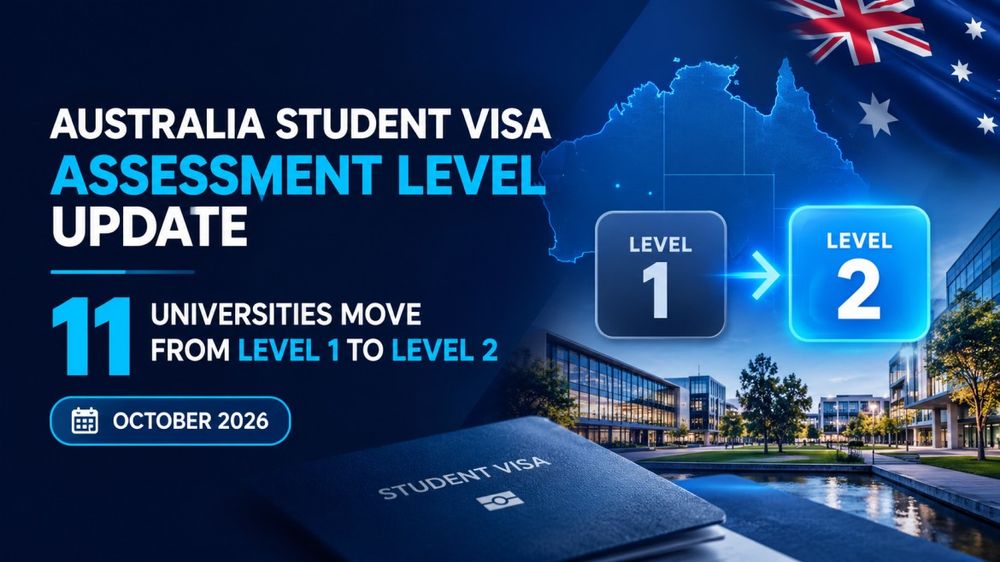
Transition of India’s Evidence Level from 2 to 3: Implications for Students Planning Higher Studies in Australia
16 Jan, 2026

Transition of India’s evidence level from 2 to 3: Implications for students planning for higher studies in Australia
After the adoption of Ministerial Direction 115 (MD115), Australia will have drastic structural changes to the procedures for student visas and overseas education. Especially with a heavy emphasis on students’ sincere statements of purpose, institutional fulfilments, and sustainable growth, this new approach transforms the prioritisation, evaluation, and processing of student visas. India is currently being evaluated under a higher-evidence-level category in this growing framework, compared to the past few years, which has drawn more attention to applications from the nation and created more concerns among applicants. Clarity and correct information are crucial because this development has alarmed parents, students and educational institutions. In recent months, due to extensive conversations on digital platforms and counselling networks, the uncertainty surrounding these changes has increased significantly. Speculative interpretations and unsupported claims have increased confusion over visa outcomes, timeframes, and approval prospects. Understanding the reasons for Australia's advancements in the risk-based assessment paradigm is essential. The revised paradigm places greater emphasis on responsibility, sincere student intention, and the sustainability of education than on exclusion. Instead of responding to incomplete or deceptive narratives circulating in the market, students and stakeholders should respond constructively with a clearer grasp of policy direction.
Comprehending Australia’s Student Visa System’s Evidence Levels
For student visas, Australia employs a risk-based assessment process. Based on these historical and statistical indicators, countries and educational sectors are categorised into evidence levels:
- Refusal rates for student visas
- Compatibility with visas and overstays
- Trends in course completion and dropout rates
- Non-genuine student trends
Restrictions or prohibitions do not follow from a higher level of evidence; rather, they suggest that applications might need additional supporting evidence, a more compelling argument, and more careful examination during evaluation.
India’s present situation: What is Confirmed
There isn't currently a single official public announcement that unambiguously states that India will move from Evidence Level 2 to Evidence Level 3 across all areas of education. What is certain, though, is that Australia's updated risk-management framework is subjecting Indian applicants to greater scrutiny. Recent trends in rejection rates, the calibre of documentation, and concerns about fraudulent applicants in specific student market sectors all affect this. The most important fact to understand is that visas for Indian students are not banned, suspended, or limited; instead, they are more. Instead, it is a more nuanced, data-driven method where candidates must clearly demonstrate financial stability, scholastic progress, and a genuine desire to learn. Indian students are still accepted, especially if they enrol through compliant universities with good student performance records.
Ministerial Direction 115's Function in the Transition
The prioritisation of student visas has been significantly changed by Ministerial Direction 115; the processing speed is now a measure of compliance under MD115. Faster visa processing is now measured by completion rates, staying within their allotted enrollment limits, and fewer fraudulent or high-risk applications. Organisations or individuals that surpass thresholds or exhibit risk indications, on the other hand, can experience delayed processing times. Due to this policy change, student nationality is no longer the only factor. Rather, the mix of past results, organisation risk rating, and student profile is crucial. Instead of a complete downgrade, this has led to a more rigorous assessment process for Indian pupils.
Handling Misinformation in the Market and False News
One of the main problems resulting from this situation is the spread of false, exaggerated, or incomplete information through social networking sites, WhatsApp communities, or video-sharing websites. Reports that "the status of India has been devalued" as well as that "visas for the country are no longer possible" have no official backing. The complexity of Australia's visa approval procedure and the fact that many Indian students continue to submit applications for and receive visas are often overlooked in these tales. Sensationalised assessments of policy amendments have caused needless anxiety among parents and students, taking focus away from what really matters: compliance and application quality.
What Indian Students Should Know About This
The consequences are obvious and practical for Indian students who intend to pursue higher education in Australia. Now, preparation must take precedence over conjecture. It is anticipated that students will present:
- A solid and rational academic path in line with the course they have selected
- Evidence-based and transparent financial records
- A clear, Genuine Student (GS) statement outlining the purpose of the study
- Choosing educational institutions with a track record of compliance and student support
- Under the current framework, students with reasonable learning plans, transparent backgrounds, and legitimate motives remain in a strong position.
Student Outcomes and Institutional Responsibility
In this changing environment, educational institutions are also very important. Higher education institutions are increasingly responsible for student outcomes, such as retention, advancement, and completion, under MD115. Favourable processing conditions are likely to be maintained by institutions that place a high priority on ethical recruitment, correct counselling, and continuous student support. Instead of volume-driven recruitment, this convergence between institutional responsibility and student quality signifies a shift toward sustainable expansion in international education. Selecting the appropriate school is now just as crucial for Indian students as putting together a compelling visa application.
Long-Term Prospects for Education Relations between Australia and India
India remains one of Australia's most important and valued partners in education, despite current concerns. Due to post-study employment prospects, internationally recognised credentials, and solid bilateral links, Indian students' interest in Australian education remains high. Rather than being a closure, the current recalibration should be seen as a course correction. Australia hopes to preserve the authenticity of its immigration policy while safeguarding learners and institutions by promoting higher standards of compliance and sincere purpose.
Concluding Remarks and Future Directions
A fair and knowledgeable perspective is required when examining the story of India's migration within Australia's evidence-level framework. Unquestionably, there is more scrutiny, but this does not mean there are fewer opportunities. The goal of Australia's updated MD115 student visa policy is to improve system integrity rather than deter legitimate foreign applicants. Instead of becoming alarmed, Indian applicants should be more aware, receive responsible counselling, and prepare carefully. Success will continue to be determined by open documentation, practical study paths, and well-informed institutional decisions. Stakeholders need to rely on reliable government sources and data-driven insights, as false information spreads quickly. In the end, students who meet Australia's standards for academic rigour and sincere intent will remain well-positioned to benefit from its highly regarded educational system and long-term employment opportunities.