LanguageCert Academic: Exam Format, Scores and University Acceptance in 2026
13 Nov, 2026
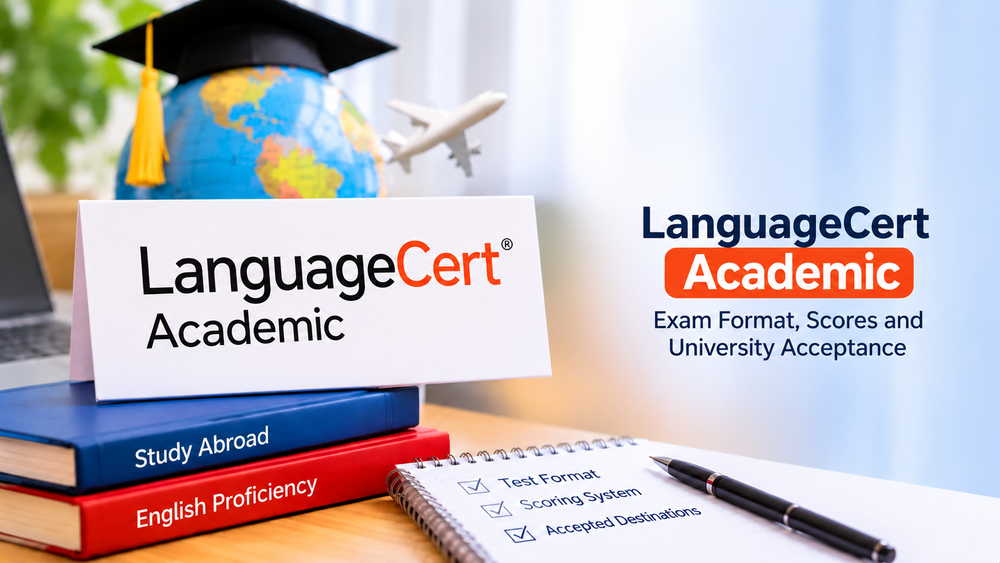
Choosing the right English proficiency test is an important step when planning to study abroad. While IELTS Academic and PTE Academic are popular choices among international students, LanguageCert Academic is another option for demonstrating English language proficiency.
LanguageCert Academic is designed for students applying to universities and higher education institutions where English is the primary language of instruction. It assesses four essential skills: Listening, Reading, Writing and Speaking. The examination also offers flexible booking options, a multilevel scoring system and separate Written and Spoken components.
However, before choosing this test, students need to understand whether their preferred universities accept it, what score they need and whether it can be used for student visa applications.
In this guide, we explain everything you need to know about LanguageCert Academic, including its examination format, scoring system, international recognition, registration process and preparation strategies. We also look at its acceptance in popular study destinations such as Australia, the UK, Ireland and New Zealand.
What Is LanguageCert Academic?
LanguageCert Academic is an international English language proficiency test developed by LANGUAGECERT, an awarding organisation that provides English language qualifications and assessments.
The examination is designed for students seeking admission to undergraduate, postgraduate and other higher education programmes where English is the medium of instruction.
Unlike examinations that assess candidates at one fixed level, LanguageCert Academic is a multilevel test covering CEFR levels B1 to C2. Candidates take the same examination, and their final scores determine their demonstrated English proficiency.
The examination evaluates four language skills:
- Listening: Understanding academic discussions, conversations and lectures.
- Reading: Comprehending academic texts and identifying important information.
- Writing: Producing organised written responses and academic essays.
- Speaking: Expressing opinions, answering questions and communicating effectively.
The test is available through authorised examination centres and online proctoring, subject to availability and the requirements of the intended application.
One important distinction is that LanguageCert Academic and LanguageCert Academic SELT are not interchangeable for every purpose. Students applying for certain UK visas may need the specific SELT version rather than the standard Academic examination.
LanguageCert Academic Exam Format and Structure
Understanding the examination format helps students prepare effectively and manage their time during the test.
LanguageCert Academic consists of two components:
- Written Component – Listening, Reading and Writing.
- Spoken Component – Speaking.
The total examination duration is approximately 2 hours and 34 minutes.
1. Listening – 40 Minutes
The Listening section assesses how effectively candidates understand spoken English in academic and everyday university-related situations.
It contains four parts with a total of 30 questions. Candidates listen to different recordings, including conversations, academic discussions, lectures and spoken explanations.
Common question formats include:
- Multiple-choice questions.
- Dialogue completion.
- Note-taking and gap-filling exercises.
- Questions based on academic discussions.
Preparation tips:
- Listen to English podcasts and university lectures.
- Practise understanding different accents.
- Focus on identifying main ideas and supporting information.
- Improve your ability to recognise keywords and paraphrased information.
2. Reading – 50 Minutes
The Reading section measures your ability to understand and interpret written English.
Candidates work with different types of texts, including academic articles, short passages and longer discussions.
The section contains four parts and 30 questions. Common question formats include:
- Multiple-choice questions.
- Vocabulary and gap-filling exercises.
- Sentence matching.
- Identifying relevant information across multiple texts.
- Understanding the meaning and arguments presented in academic passages.
Preparation tips:
- Read English newspapers and academic articles regularly.
- Improve your vocabulary and comprehension skills.
- Practise identifying the main idea of a passage.
- Learn to understand unfamiliar words through context.
- Manage your time carefully.
3. Writing – 50 Minutes
The Writing section evaluates your ability to communicate ideas through organised academic writing.
It contains two tasks. The first task requires candidates to write a 150–200-word academic report or article based on an infographic or other visual information.
The second task involves producing an approximately 250-word discursive response on an academic subject. Candidates may need to present arguments, express opinions, evaluate ideas or support a particular viewpoint.
Your writing is assessed based on factors such as:
- Grammar and sentence structure.
- Vocabulary range and accuracy.
- Organisation and coherence.
- Relevance to the given topic.
- Clarity of ideas and arguments.
Preparation tips:
Practise writing essays and reports within the specified word limits. Learn to organise your responses with clear introductions, supporting paragraphs and conclusions. Avoid unnecessarily complicated vocabulary and focus on communicating ideas accurately.
4. Speaking – Approximately 14 Minutes
The Speaking section assesses your ability to communicate confidently and effectively in English.
Unlike fully computer-recorded speaking examinations, LanguageCert Academic includes a live one-to-one interaction with a trained interlocutor.
The Speaking test consists of four parts:
- Questions: Answer introductory questions and discuss different topics.
- Role-play: Respond to situations presented by the interlocutor.
- Reading aloud: Read a short academic text and answer related questions.
- Presentation: Prepare and deliver a short presentation on an academic subject, followed by questions.
Preparation tips:
Practise speaking English regularly, improve your pronunciation and learn to express opinions clearly. Instead of memorising answers, focus on developing natural communication skills.
How Is LanguageCert Academic Scored?
LanguageCert Academic uses the LANGUAGECERT Global Scale, which ranges from 0 to 100.
Candidates receive individual scores for Listening, Reading, Writing and Speaking, along with an overall score and corresponding CEFR level.
The Common European Framework of Reference for Languages (CEFR) is an international framework used to describe language proficiency.
The score ranges are:
- 90–100: C2 – Proficient
- 75–89: C1 – Advanced
- 60–74: B2 – Upper Intermediate
- 40–59: B1 – Intermediate
Certificates are issued for scores corresponding to B1–C2 levels.
What Is a Good LanguageCert Academic Score?
The required score depends on the university, programme and destination country.
For example, a university may require B2-level proficiency for an undergraduate programme, while a postgraduate or specialised course may require C1-level proficiency.
Some institutions also specify minimum scores for individual skills. Therefore, achieving the required overall score may not be sufficient if your Listening, Reading, Writing or Speaking score falls below the university's minimum requirement.
LanguageCert Academic Score Compared with IELTS
LANGUAGECERT publishes recommended score comparisons between LanguageCert Academic and IELTS Academic.
Some commonly used comparisons include:
- LanguageCert 60 = IELTS 5.5
- LanguageCert 65 = IELTS 6.0
- LanguageCert 70 = IELTS 6.5
- LanguageCert 75 = IELTS 7.0
- LanguageCert 80 = IELTS 7.5
- LanguageCert 85 = IELTS 8.0
These comparisons help students understand the relationship between the two scoring systems. However, they do not guarantee that universities or immigration authorities will treat both tests as interchangeable.
Always check the exact English language requirements of your intended institution.
Which Countries Accept LanguageCert Academic?
International recognition is one of the most important considerations when selecting an English proficiency test.
LanguageCert Academic is recognised by several international institutions and authorities. However, acceptance differs depending on the destination, university, course and visa category.
1. Australia
Australia is a popular destination for international students interested in business, engineering, healthcare, information technology and other academic fields.
LanguageCert Academic is accepted by Australia's Department of Home Affairs as English proficiency evidence for visa applications that require proof of English language ability, including student visas.
However, students applying for Australian visas must take the relevant LanguageCert Academic examination at an authorised test centre. Online-proctored examinations should not be assumed to meet Australian visa requirements.
University admission requirements must also be checked separately because minimum scores can differ between institutions and courses.
Students planning to study in Australia should also review the Australia study abroad requirements and admission guidance before selecting an English proficiency test.
2. United Kingdom
The UK is another important destination where LanguageCert has specific recognition.
For students applying to degree-level courses at eligible UKVI-licensed higher education institutions, the standard LanguageCert Academic test may be accepted when the institution assesses the student's English proficiency.
However, students applying for below-degree-level courses or institutions outside the relevant higher education category may need the UKVI-approved LanguageCert Academic SELT examination.
The standard Academic test and SELT version have the same examination content, but the SELT version provides the required reference information for applicable UK visa applications.
Students should confirm the correct test version with their university before registration.
3. Ireland
Ireland has become an attractive destination for international students interested in business, information technology, engineering and healthcare programmes.
The Irish Department of Justice recognizes LanguageCert Academic as evidence of English proficiency for relevant student visa applications.
However, individual universities and departments may have different admission requirements. Students should confirm the minimum overall score and individual skill requirements before booking the examination.
4. New Zealand
New Zealand offers international students opportunities to pursue undergraduate, postgraduate and professional qualifications.
LanguageCert Academic is recognised by the New Zealand Qualifications Authority (NZQA) for admission to international study programmes.
However, students should still confirm the specific English proficiency requirements of their chosen education provider. Institutional requirements may differ depending on the course and qualification.
5. Germany
Germany is a popular destination for students interested in engineering, technology, research and business programmes.
However, acceptance of LanguageCert Academic is not universal across German universities.
Some institutions specify IELTS or TOEFL, while others may accept additional English proficiency examinations.
Students should check their university's official admission requirements before selecting LanguageCert Academic.
How to Register for LanguageCert Academic
Registering for LanguageCert Academic involves a few straightforward steps.
Step 1: Visit the official website
Visit the LANGUAGECERT website and select the LanguageCert Academic examination.
Step 2: Choose your examination method
Select an available authorised test centre or online-proctored examination. Make sure your chosen format meets your university and visa requirements.
Step 3: Select your examination components
Choose the Written and Spoken components. You can schedule both on the same day or on separate days, provided they are completed within 14 days of each other.
Step 4: Complete your registration
Enter your personal information and identification details. Ensure that your details match your official identification document.
Step 5: Make the payment
Complete the examination fee payment through the official registration platform and check your confirmation email for examination details.
Students can access registration and examination information through the official LanguageCert website.
LanguageCert Academic Fees and Results
The examination fee depends on the selected delivery method and country.
The official LANGUAGECERT website displays different prices for online and test-centre examinations. Students registering from India should check the latest applicable fee, taxes and booking charges before making payment.
LANGUAGECERT currently publishes the following general examination result timeline:
- Official results are generally available within five working days.
- Candidates can access their results through their online account.
- The Test Report includes individual skill scores, an overall score and CEFR level.
- Additional performance feedback is provided for Writing and Speaking.
Students should allow sufficient time for result processing before university application and visa deadlines.
How to Prepare for LanguageCert Academic
Preparing for LanguageCert Academic requires a balanced approach because the examination evaluates all four English language skills.
Here are some practical ways to prepare:
1. Practise listening regularly
Listen to English podcasts, educational videos and academic lectures. Focus on understanding the main ideas, supporting details and speakers' opinions.
2. Improve reading comprehension
Read newspapers, articles and academic materials. Practise identifying important information and understanding unfamiliar vocabulary through context.
3. Develop writing skills
Write essays, reports and structured responses regularly. Pay attention to grammar, sentence organisation and word limits.
4. Improve speaking confidence
Practise answering questions, explaining opinions and delivering short presentations. Focus on pronunciation, fluency and clear communication.
5. Use official practice materials
Refer to the official LanguageCert sample papers, preparation guides and familiarisation resources. Attempting practice questions under timed conditions will help you understand the examination pattern and identify areas that need improvement.
Students should begin preparation based on their current English proficiency rather than following a fixed preparation period.
Conclusion
LanguageCert Academic provides international students with another option for demonstrating their English proficiency when applying to higher education institutions abroad. Its four-skill assessment, multilevel scoring system, flexible examination scheduling and international recognition make it worth considering alongside IELTS and PTE.
However, choosing the right examination requires more than comparing test formats and scores. Students should verify whether their preferred university accepts LanguageCert Academic, what minimum overall and individual skill scores are required, and whether the examination format meets the destination country's visa requirements. For students planning to study in Australia, understanding the latest Australian student visa assessment level updates can also help them stay informed about changing visa requirements.
Before booking the test, review the official admission guidelines, confirm the accepted examination version and allow sufficient time for preparation and result processing. If you are considering multiple study destinations, compare their English language requirements before making a decision.The wider study-abroad process also involves university selection, admission criteria and destination-specific requirements, which form part of the broader landscape of best overseas education consultants in Kerala.
Ultimately, the right English proficiency test is one that matches your academic goals, demonstrates your language ability and meets both university admission and visa requirements. Planning these details early can help you avoid unnecessary expenses and delays during your study abroad application.
Frequently Asked Questions
1. Is LanguageCert Academic accepted for studying abroad?
Yes. LanguageCert Academic is accepted by various international universities and institutions. However, acceptance depends on the university, programme and destination country.
2. Is LanguageCert Academic accepted in Australia?
Yes. Australia's Department of Home Affairs accepts LanguageCert Academic for visa applications requiring English proficiency evidence. The examination must be taken at an authorised test centre for Australian visa purposes.
3. Is LanguageCert Academic accepted in the UK?
Yes. Eligible UK higher education institutions can accept the standard LanguageCert Academic test for degree-level admissions. Certain other UK visa applications require the UKVI-approved LanguageCert Academic SELT version.
4. Is LanguageCert Academic easier than IELTS?
The difficulty depends on the candidate's English proficiency and familiarity with the examination format. Students should compare the question patterns and assessment methods before choosing a test.
5. What is the maximum score in LanguageCert Academic?
The maximum score is 100 on the LANGUAGECERT Global Scale. Candidates receive individual scores for all four skills and an overall result.
6. How long does LanguageCert Academic take?
The complete examination takes approximately 2 hours and 34 minutes, including Listening, Reading, Writing and Speaking.
7. Can I take LanguageCert Academic online?
Yes. Online-proctored examinations are available. However, certain visa applications, including Australian visa applications, require a test-centre examination.
8. How long is the LanguageCert Academic certificate valid?
LANGUAGECERT certificates do not have an official expiry date. However, individual universities and immigration authorities may impose their own validity requirements.
9. Can I take the Speaking test separately?
Yes. The Spoken component can be scheduled separately from the Written component. Both components must be completed within 14 days of each other.
10. Is LanguageCert Academic accepted in Germany?
Acceptance depends on the individual university and programme. Students should verify the accepted English proficiency examinations directly with their intended institution.